





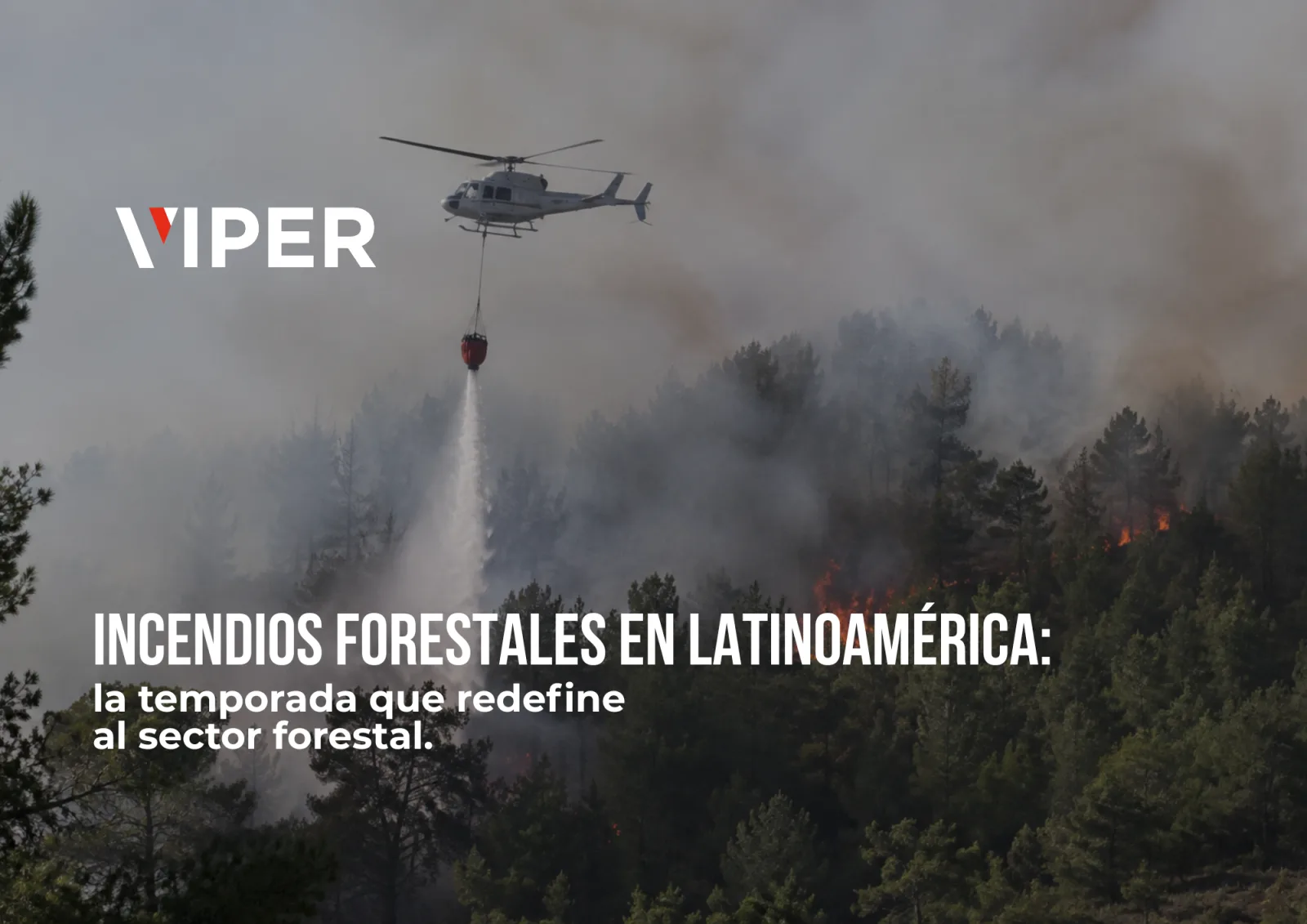
The forest fire season stopped being a seasonal event and became a permanent risk for the forestry industry throughout Latin America. Between 2025 and 2026, countries such as Chile, Bolivia, Brazil, Mexico, Argentina and Colombia faced fire episodes that were increasingly extensive, more intense and more difficult to control, in a context aggravated by the El Niño phenomenon and climate change. For forestry companies, this is no longer just an environmental emergency: it is an operational, financial and reputational problem that requires new response capabilities.
A phenomenon that is repeated throughout the region
In Chile, the 2026 season was one of the most devastating in its recent history. In the Biobío Region alone, more than 31,800 hectares (1) were burned, within a national total that exceeded 34,000 hectares (1) in the early stages of the summer. The human toll was equally harsh: 21 people died, more than 330 injured, some 22,000 victims and more than 4,100 homes destroyed (1), mainly in Biobío and Ñuble. Reconstruction costs are estimated between US$300 and US$600 million (1).
Bolivia is experiencing an even more structural crisis: between 2023 and 2024, its forest loss due to fires grew by 200% (2), devastating nearly 11.5% of the national territory (2), and in July 2026 the country once again declared an emergency in the east and south due to new outbreaks, aggravated by water scarcity and diesel to combat them (3). In the Amazon, Brazil also recorded a doubling of forest loss compared to the previous year, with six Latin American countries among the ten with the greatest loss of tropical forest on the planet (2). Mexico, for its part, burned 1.67 million hectares in more than 8,000 fires (2), the largest area affected since 1998 (2). And by 2026-2027, climate science anticipates that El Niño could further intensify fires in Colombia, Argentina, and the rest of the region (4).
The economic blow to the forestry industry
For the forestry sector, the impact does not end when the last light bulb goes out. In Chile, forestry exports fell 7% during 2025 (5), with monthly falls of up to 40% in producing regions such as Biobío (5) and declines of more than 69% in imports from China in some months (5). Added to this is a fundamental regulatory challenge: since May 2026, the European Union requires satellite traceability that certifies that wood does not come from lands deforested after 2020 (EUDR), which has already generated shipment retentions in ports such as Rotterdam and Hamburg (5). Chile responded by adapting its PEFC certification to this standard, with 1.1 million hectares already certified (5), in what is today seen as a way of recovery and market differentiation.
The response: from fighting fire to anticipating it
Faced with this scenario, the largest forestry companies in the region are running towards the same place: prevention based on data and continuous monitoring. Robotic cameras with artificial intelligence capable of detecting smoke in less than two minutes (6), night surveillance drones, satellite images, coordination planes and professional brigades are already part of the operating standard of companies such as Arauco, which reports a 42% reduction in fires fought between 2023 and 2024 thanks to this strategy (6).
A brief opinion on this: among the voices from the forestry sector that are often commented on and shared on LinkedIn is that of Ramon José de Souza Santos, forestry coordinator of Arauco in Mato Grosso do Sul, Brazil, who summarized the underlying idea well in recent statements: "fire does not respect property boundaries" (7), so real-time surveillance and coordination must extend beyond one's own property. We agree with that reading: detection technology is already a minimum condition, not a competitive advantage. What today makes the difference between a controlled emergency and a tragedy is how quickly that information reaches the person who must make the decision, and with what level of coordination there is action between brigades, firefighters and authorities.
What's coming
The regional trend is clear: longer, more intense seasons and with less room for reaction. The difference between a resilient forestry company and one exposed to million-dollar losses increasingly plays out in the speed and quality of information during the emergency. At VIPER we work precisely on that critical layer: that the right information reaches the right team at the right time, when every minute counts.
Sources:
- United Nations in Chile — Forest fires 2026: Situation Report N°3
- Mongabay — Wildfires push tropical forest loss in Latin America to record highs
- Infobae — Forest fires spread in eastern and southern Bolivia in amid water and diesel shortages
- Mongabay — From Colombia to Argentina: how El Niño could intensify forest fires in 2026 and 2027
- ASEMAFOR — Chilean forestry sector 2026: among the ashes, European regulations and a market that seeks to recover
- Empresas Copec Corporate Magazine — ARAUCO and its new strategy against forest fires: anticipation is the key
- Perfil News — Florestas Protection Day: technology and monitoring helps Arauco prevent fires in Mato Grosso do Sul