





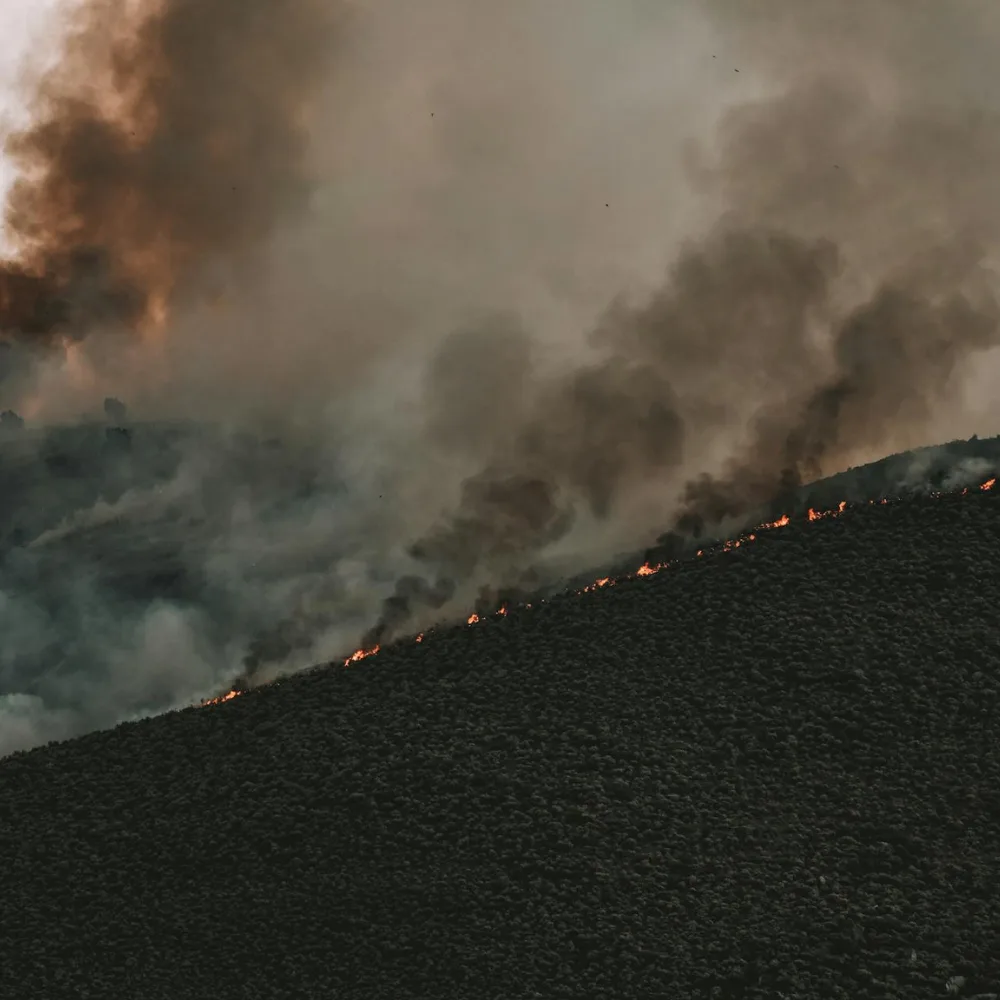
On Thursday, December 25, in a telephone interview with Camila Jara on Radio BioBio, we address an uncomfortable but inevitable topic: the forest fire season is already underway and that day they were reported 10 active spotlights in the country.
At VIPER we enter that conversation from a practical angle: when an emergency grows, the first thing that breaks is not the will to respond, but the coordination.
The real problem: when the emergency exceeds local capacity
In the interview, Camilo (our Director of Operations) explained why, in forest fires and large-scale emergencies, the main challenge is organize mutual support between institutions, under principles of disaster risk management and reduction: collaboration with neighbors and staggered use of resources.
That specific need was the origin of SIDER (Regional Dispatch System): a regional coordination layer that allows moving from a “per body” response to a response by region, with operational control and real-time visibility.
What is SIDER: a “supracentral” to coordinate regional resources
SIDER operates as a regional coordinating center (“supracentral”) that consolidates a region's resource availability and enables coordinated dispatches when a commander requests additional support.
To ground it with an example mentioned in the air: in the event of an interface fire in Florida (with a yellow alert until minutes before), the incident commander requested reinforcements and regional coordination was activated to arrange three tanker trucks in support of the work of the Ñuñoa Fire Department, with immediate dispatch from regional availability.
In the Metropolitan Region, this coordination is translated on a real scale: 23 fire departments and more than 370 emergency vehicles available for regional support when the situation demands it.
Coverage and deployment: from local platform to regional integration
In the interview we share figures that explain why this approach works: today we work with around 124 fire departments, which is equivalent to ~82–84% population coverage (especially in big cities).
Where SIDER is already implemented (such as in the RM), the coverage reaches 100%. At the operational infrastructure level, there was talk of an order of ~400 barracks connected and concurrent in a source of information.
About the evolution: VIPER left almost 10 years delivering notification to firefighters (in the interview “DIPER” is mentioned, as a reference to the “pager” type concept), and the regional integration fulfilled two years in the MRI, already expanding to three additional regions, with two more in installation.
It's not just firefighters: multi-organization coordination
One of the central points was that SIDER is not limited to “firefighters with firefighters.” At VIPER we integrate information intra-institutional and inter-institutional, scaling to a model multi-organization so that, in the same emergency, the available resources are the most efficient (firefighters, health/ambulances, public safety).
And this is supported by an architectural decision: the platform is in the cloud and it is developed in Chile by our team, which facilitates deployment, scalability and operational standardization.
Forest fires: integration of information with CONAF and SENAPRED, more signals from the ground
In the most direct section about the fire season, it was explained that we are promoting an integration effort to cross-reference information between firefighters, CONAF, SENAPRED and regional risk prevention offices, enabling coordination and shared vision for decision-making.
In addition, the integration of additional sources such as neighborhood complaints and publications in social networks, where the system compares signals with already dispatched emergencies and, if it detects a new one, raises an alert to the corresponding operator (the example was given of identifying a location and notifying the territory operator, as in Linares).
The root cause: prevention and education
Camilo also made a hard point: more than 98% of the causes of forest fires are anthropic, that is, they derive from human action due to intention or carelessness. This requires maintaining prevention and education as a structural strategy, while the operational response is strengthened with coordination and preparation.
Purpose and operational focus
The interview closed with the definition that guides the work: at VIPER we continue to build technology to operate in the first critical minute, coordinating better and faster, with an explicit purpose: “save a life every day”.